

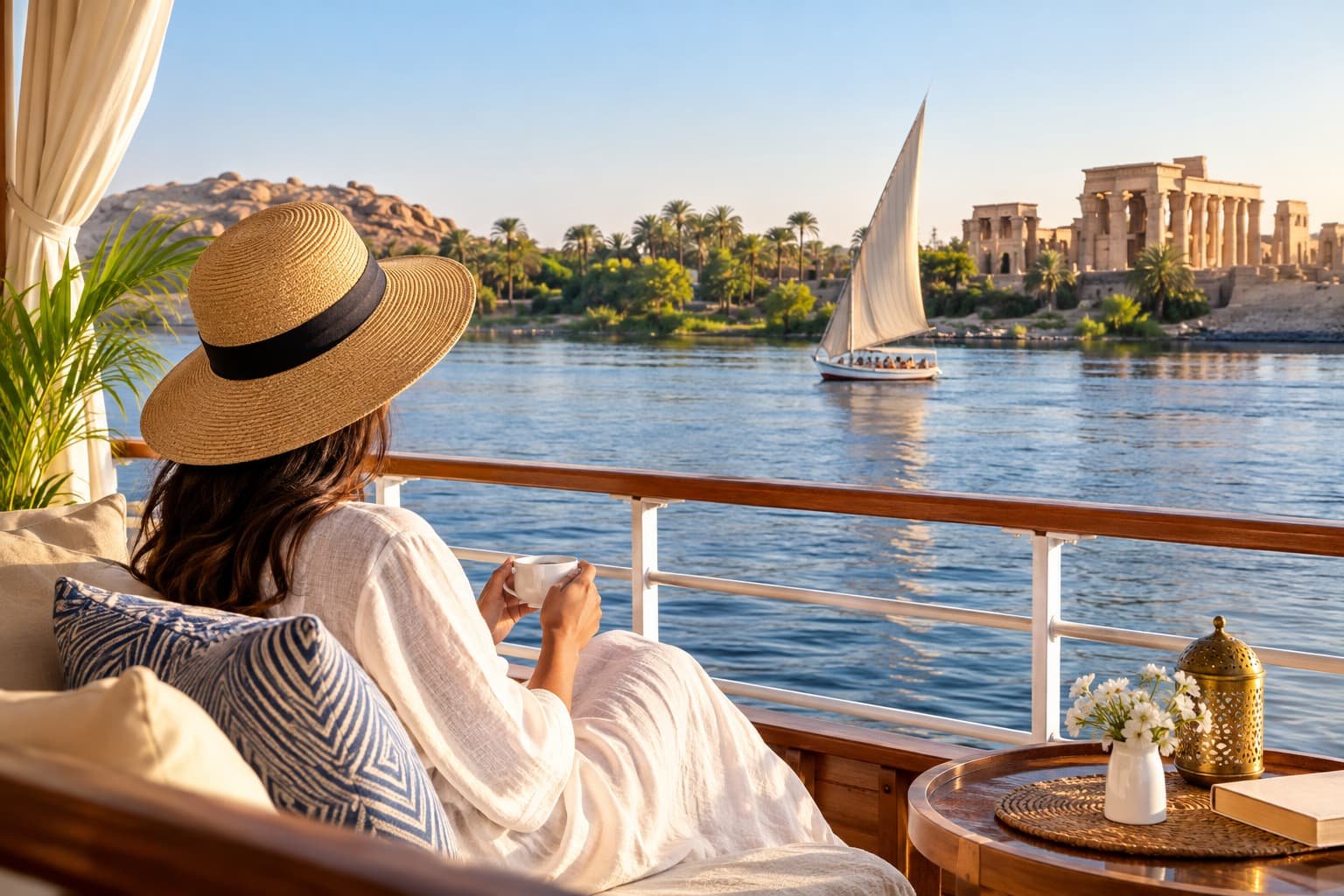
Here is something almost no page on the internet will tell you plainly: the phrase “women’s Nile cruise” is used to describe three completely different products, at three very different price points, with three very different experiences on board.
Some of them put you on a boat where every single guest is a woman. Most of them do not.
If you book without knowing which one you’re buying, you can arrive in Luxor expecting a private, all-female sailing and find yourself on a 140-passenger ship with a disco on the top deck travelling with a lovely group of twelve women, but surrounded by honeymooners, families and a stag party from Manchester.
This guide separates the three types, gives you real price ranges for each, and then answers the practical questions that actually decide whether your trip is comfortable: what to wear, what the cabins are really like, whether you can get a female guide, what happens on the sundeck, and how much a single cabin actually costs.
If you’re at the very start of planning, our general guide on what to know before you book any Nile cruise covers the basics this page assumes.
What Exactly Is a “Women’s Nile Cruise”?
There are three distinct products sold under this name.
Type 1: An All-Female Group on a Standard Cruise Ship
This is by far the most common, and it is what you are buying in roughly nine out of ten cases.
You travel with a group of women, usually 8 to 20, led by a guide. Your sightseeing, meals, transfers and evenings are all with that group. But the ship itself is a normal Nile cruiser carrying 60 to 150 guests of all kinds. Your cabins are scattered across the same decks as everyone else’s. The restaurant, the pool and the lounge are shared.
What this means in practice: you get the companionship, the shared table and the “never alone at dinner” benefit of women-only travel. You do not get a women-only environment in the literal sense.
For most travellers this is genuinely fine, and the group dynamic is the point. If you’ve never travelled this way before, how women-only group tours actually work covers what the day-to-day dynamic is really like. But if your reason for searching was privacy or a female-only space, this is not it, and you should not let a brochure imply otherwise.
Type 2: A Fully Chartered Women-Only Boat
Here the entire vessel is booked for your group. Every guest on board is a woman. In practice, this only works on small boats, because chartering a 140-cabin ship is financially impossible for a group of fifteen.
That makes the dahabiya a traditional two-masted sailing boat with roughly 5 to 12 cabins the realistic option. A group of 10 to 20 women can take the whole boat. The crew is small and fixed. There are no strangers on the sundeck. You set the pace, and you can moor at quiet sandbanks that the big ships can’t reach.
This is the only version that is women-only in the true sense of the phrase, and almost no one selling “women’s Nile cruises” explains that.
Type 3: A Standard Cruise With Female-Friendly Arrangements
No women’s group at all. You travel independently or with friends on a regular cruise, but the operator arranges things around you: a female guide, a cabin on a quieter deck, no forced cabin-sharing, a private vehicle for transfers.
It is the cheapest and most flexible route, and for confident solo travellers it is often the smartest one. What you lose is the built-in group.
Is a Nile Cruise Safe for Women? An Honest Answer
Yes, and a Nile cruise is one of the more protected ways to see Egypt, because you sleep in the same locked room for the whole trip and move between sites as a group rather than navigating cities alone.
But “safe” is too vague to be useful. Here is what it actually looks like. This section is about the cruise itself — for the country as a whole, start with our safety and comfort guide for women travelling to Egypt.
On Board
The ship is a closed environment with a fixed crew, a reception desk staffed overnight, and controlled access at the gangway. Cabin doors lock from the inside, and most boats provide an in-room electronic safe. Life jackets, fire alarms and an evacuation plan are standard on licensed vessels, and most 5-star boats keep a doctor on call.
Two things worth asking about specifically: whether your cabin door has a secondary latch, and whether the boat has a reading room or quiet lounge. A place to sit alone in the evening without being at the bar is more valuable than it sounds.
At the Temples and Sites
The sites themselves are patrolled and busy. What you will encounter is commercial persistence rather than danger: vendors, carriage drivers in Edfu, men offering to take your photo and then asking for money, guards inside tombs who point at a detail and then expect a tip.
None of this is aggressive. It is relentless. The effective response is a flat, friendly “no thank you” without stopping, without smiling apologetically, and without engaging in conversation. Hesitation is read as interest. Walking on is read as no.
For the longer version, what to say, when to involve your guide, and how this differs between Cairo, Luxor and the Red Sea, see our guide to practical tactics for handling attention and harassment in Egypt.
If You Are Travelling Solo
The genuine differences for solo travellers are logistical, not safety-related: the single supplement, being seated alone at meals, and having no one to hold your bag at the tomb entrance. A group tour solves all three. A private guide solves the third.
What Actually Goes Wrong
In order of how often it happens:
1. Heat. By a wide margin the most common problem, and it lands hardest on travellers over 60. See the timing section below, and our wider piece on the real risks of travelling in Egypt.
2. Stomach upsets. Drink bottled water, including for brushing teeth. Be cautious with salads and cut fruit at buffets on the first two days.
3. Overpaying. Not dangerous, just irritating. Agree carriage and taxi fares before you get in.
4. Unwanted comments. Occasional, usually in crowded markets rather than at sites or on board. Sunglasses, headphones and a purposeful walking pace end almost all of it.
Serious incidents involving tourists on Nile cruises are rare. Discomfort from heat and dehydration is not.
What to Wear on a Women’s Nile Cruise
Egypt is more relaxed than many visitors expect, and stricter than the brochure photos suggest. The answer depends entirely on where you are standing.
This section covers the cruise specifically. For the wider picture across Cairo, the Red Sea and everyday situations, see our full guide to what to wear as a female tourist in Egypt.
On the Sundeck
Swimwear is normal and expected. Bikinis are fine. The crew are used to it and nobody will comment.
The thing nobody mentions: cruise ships moor side by side, sometimes three or four deep, and you walk through other boats’ lobbies to reach the shore. When your boat is in the middle of a stack, the ship next to you is a few metres away at the same deck height. Bring a cover-up or a kaftan for those moments, and expect the quietest sunbathing on sailing afternoons rather than in port.
At Temples and Tombs
Shoulders and knees covered. Loose trousers or a long skirt with a light long-sleeved shirt is the standard, and it is also simply the coolest thing to wear under direct sun; bare skin in 38°C is a mistake, not a freedom.
No head covering is required at any archaeological site.
Shoes matter more than clothes. Tomb ramps are steep, dusty and often slippery. Closed shoes with grip, not sandals.
In Nubian Villages, Markets and Mosques
Cover shoulders and knees, and carry a scarf. For a mosque visit, you’ll need to cover your hair, remove your shoes, and wear something that reaches the ankles and wrists; many mosques lend a robe at the entrance.
In markets, more coverage means noticeably less attention. This is not a rule; it is a practical observation.
Cairo vs Luxor vs Aswan
Cairo is the most cosmopolitan; you’ll see Egyptian women in everything from full niqab to jeans and no headscarf. Luxor and Aswan are smaller and more conservative, and visitors are more visible. Aswan’s Nubian communities are warm and used to tourists but appreciate modest dress.
Cabins, Sharing, and the Single Supplement
This is the section that decides your budget, and it is the one most pages skip.
What You’ll Actually Be Offered
A typical 5-star Nile cruiser has around 60 to 75 cabins, broken down roughly as follows:
• Twin cabins — the majority, two separate beds, usually 16–20 m²
• Double cabins — one large bed, fewer of them
• Single cabins — genuinely rare. A large ship may have only two, and they are smaller
• Convertible triples — a large bed plus a sofa bed, useful for three friends
• Suites — a handful, 30–40 m², usually on the upper deck
Standard cabin fittings: private bathroom with shower, air conditioning, a mini fridge, an electronic safe, a telephone, and a satellite TV that generally only works while docked. Most cabins have panoramic windows; upper decks may have French balconies. Nearly all cabins on modern boats are non-smoking.
Deck matters more than category. Lower-deck cabins sit near the waterline and the engine, and are noticeably noisier at night. Upper-deck cabins are quieter and better lit and cost more. If you are a light sleeper, pay the difference.
Routes and Itineraries
Every Nile cruise sails the same 200 km stretch between Luxor and Aswan. What changes is the direction, the number of nights, and how much of it is spent moving.
Luxor → Aswan, 4 nights. The most popular, and the one to choose for a first visit. Luxor’s East and West Banks, then Esna Lock, Edfu, Kom Ombo, and Aswan. Sailing runs mostly during the day, so you actually see the river.
Aswan → Luxor, 3 nights. Shorter and cheaper, but compressed. You get the same temples with less time at each. Choose it only if your total trip is tight.
The direction changes more than the order of the temples: sailing time, sunlight on deck, and how rushed the final day feels all shift. We compared both in choosing between Luxor to Aswan and Aswan to Luxor.
7 nights, round trip. Luxor to Aswan and back. More sailing time, more relaxed, and a better fit if the boat itself is part of the holiday rather than just transport. Also the easiest way to fit Abu Simbel in without rushing.
Adding Cairo. Most complete Egypt itineraries pair the cruise with 2–3 nights in Cairo for the Pyramids, the Grand Egyptian Museum and Khan el-Khalili, connected by a one-hour domestic flight. Budget 8 to 10 days for the full picture; see how a Cairo, Nile cruise and Red Sea itinerary fits together.
Adding Abu Simbel. From Aswan, either a 3-hour road transfer each way or a short flight. It is a long day, and it is worth it. If you have the time, an 11-day Egypt itinerary absorbs it comfortably.
Can You Request a Female Guide?
Yes, and you should ask, because it will not be offered.
Egypt licenses female Egyptologists, and there are excellent ones working in Luxor and Aswan. They are, however, a minority of the guiding workforce, which means availability is genuinely limited rather than artificially limited. A request made at the time of booking can almost always be met. A request made three days before arrival often cannot.
Some things worth knowing:
• There is normally no extra charge for requesting a female guide on a private tour. If an operator adds a fee, ask why.
• On a fixed group departure, the guide is assigned to the group, so this is easier to arrange on private or small-group trips.
• A female guide changes the experience in small, practical ways. Questions about bathrooms, clothing, comfort in the heat or feeling unwell are simply easier to ask.
If it matters to you, put it in writing when you pay the deposit, and ask the operator to confirm the guide’s name before you travel.
Best Time of Year for a Women’s Nile Cruise
The Nile Valley is one of the hottest inhabited places on earth in summer. This is the single most consequential booking decision you will make.
|
Month |
Aswan daytime high |
Crowds |
Price |
Verdict |
|
Oct |
36–38°C |
Building |
Mid |
Excellent |
|
Nov |
30–33°C |
High |
Mid–high |
Ideal |
|
Dec |
25–28°C |
Peak |
Highest |
Ideal, but busy and expensive |
|
Jan |
23–26°C |
Peak |
Highest |
Ideal, cool evenings |
|
Feb |
26–29°C |
High |
High |
Ideal |
|
Mar |
31–34°C |
High |
Mid–high |
Excellent |
|
Apr |
36–39°C |
Moderate |
Mid |
Good, warming fast |
|
May |
40–43°C |
Low |
Low |
Only if heat-tolerant |
|
Jun–Aug |
41–45°C+ |
Lowest |
Lowest |
Avoid unless you know exactly what you’re taking on |
|
Sep |
38–40°C |
Building |
Low–mid |
Manageable late in the month |
The honest recommendation: October, November, February and March are the sweet spot — warm enough for the sundeck, cool enough to stand in the Valley of the Kings at midday. December and January are the most comfortable but also the most expensive and the most crowded.
For the trade-offs beyond the Nile Valley — Cairo, the Red Sea and shoulder-season pricing see our breakdown of summer versus winter in Egypt.
If you are over 60, or you have any cardiovascular or respiratory condition, treat June to August as off-limits regardless of how good the price looks. Tomb interiors are unventilated and can be 5–8°C hotter than outside.
One exception to the summer rule. On 2 August 2027, Luxor sits directly in the path of a total solar eclipse one of the longest of the century. It is the only reason we would tell anyone to be in Upper Egypt in August, and cruise cabins for that week are already being held. If that is your trip, read about the total solar eclipse over Luxor on 2 August 2027 and book far earlier than you normally would.
Ramadan shifts by about 11 days each year. During Ramadan, sites and museums keep shorter hours, some restaurants close during daylight, and alcohol service is reduced in some places though cruise ships generally continue to serve guests normally. The atmosphere in the evenings is wonderful. Check the dates for your travel year before you book.
How Much Does It Cost?
Prices are per person, sharing a double cabin, for a 4-night Luxor–Aswan cruise including full board, guided excursions and entrance fees. These are women’s-trip ranges; for the wider market, including where discounts are real and where they are just repackaging, see real Nile cruise costs and where the savings actually are.
|
Tier |
Range |
What you get |
|
Budget |
$600–$900 |
Older boat, lower deck, smaller cabin, larger group |
|
Mid-range |
$900–$1,700 |
Well-maintained 5-star boat, upper deck available, group of 12–20 |
|
Deluxe |
$1,700–$2,600 |
Newer ship, spacious cabin, better food, smaller group |
|
Luxury / charter |
$2,600–$5,000+ |
Premium vessel or private dahabiya charter |
A Note on Egyptian Star Ratings
Almost every Nile cruiser in Egypt is marketed as “5-star”. The rating is issued locally and does not map to European or North American standards. A useful translation:
|
Marketed as |
Realistically comparable to |
|
5-star standard |
European/US 3-star |
|
5-star deluxe |
European/US 3.5-star |
|
5-star ultra deluxe |
European/US 4-star |
|
5-star luxury |
European/US 5-star |
Ask which of these four bands your boat sits in. Any honest operator will tell you.
Costs That Are Usually Not Included
• Single supplement — 40–75%
• Egypt entry visa — check current requirements and fees for your nationality before travel
• Special-access tickets — Tutankhamun’s tomb, the tomb of Seti I and the tomb of Nefertari all require separate tickets beyond the standard Valley of the Kings entry
• Hot air balloon over Luxor — typically $80–$150
• Drinks — including bottled water in some cases. Ask.
• Tips — budget realistically (below)
• Travel insurance — not optional in practice
If you are weighing the cruise against staying in hotels and driving between cities, we broke the value question down in is a Nile cruise worth the money.
Tipping
Tipping is expected, and it is a meaningful part of income for guides and crew. Typical guidance:
|
Role |
Suggested |
|
Tour guide, full day |
$15–20 per person per day |
|
Driver, full day |
$3–5 per person per day |
|
Cruise crew |
$5–10 per person per night, at the end |
|
Dahabiya crew |
$10–20 per person per night |
|
Hotel porter |
$1–2 per bag |
The practical advice most guides won’t give you: carry small US dollar bills or Egyptian pounds in small denominations from day one. The most awkward tipping moments happen when you only have a $50 note and no change. Get change at the airport or your first hotel, keep it separate from your main wallet, and you’ll never have to work out an amount in public.
How Physically Demanding Is It?
Most operators rate a Nile cruise as their easiest activity level, and that is fair, but “easy” here means easy walking, not no walking.
What you’ll actually do:
• Valley of the Kings — a long approach on open ground, then a descending ramp into each tomb, sometimes 40–60 metres at a noticeable gradient, with the same climb back out. In heat. This is the hardest part of the trip.
• Karnak Temple — roughly 1.5 km of walking on uneven stone, largely without shade
• Boarding and disembarking — a gangway with a handrail, and when boats are moored side by side you cross through other vessels’ lobbies, which means a few short flights of stairs
• Edfu — a horse-drawn carriage from the mooring to the temple. It is a step up into the carriage, and the ride is bumpy
• Cabin access — most cruisers have no lift between decks
If mobility is a concern: ask for a mid or upper deck cabin near the stairs, ask your guide to select the flattest of the open tombs, and say clearly at the start of the trip that you’d like a slower pace. Guides adjust readily when asked and not at all when not asked.
If pace is a standing concern rather than a passing one, we run slower-paced tours designed for older travellers with shorter site visits and longer rest windows.
What to Pack:
Essentials
• Loose long trousers and long skirts two or three
• Long-sleeved light shirts in cotton or linen
• A large scarf (shade, mosques, air conditioning, dust)
• Closed shoes with grip for tombs
• Swimwear plus a cover-up or kaftan
• Wide-brimmed hat and proper sunglasses
• High-SPF sunscreen, expensive and limited in choice locally
• A refillable water bottle
• A small torch (tomb interiors are dim)
• Wet wipes and hand sanitiser
• A light layer for evenings, December to February
• Small-denomination notes for tips
• One smarter outfit; most boats hold a galabeya night
Feminine Hygiene and Pharmacies
Pharmacies in Luxor and Aswan are well stocked, easy to find, and staffed by pharmacists who usually speak some English. Sanitary pads are widely available. Tampons are not they are hard to find outside Cairo and international-brand stores. Bring your own supply if you use them.
Painkillers, rehydration salts and anti-diarrhoea medication are all available over the counter and cheap. Bring anything prescription-only in its original packaging with the prescription.
Contraceptive pills should be brought with you rather than sourced locally.
How to Choose a Reputable Operator
Twelve Questions to Ask Before You Book
Send these by email so you have the answers in writing.
1. Is the boat women-only, or is my group women-only? A vague answer here is the biggest red flag on this list.
2. What is the name of the vessel? “A 5-star cruiser” is not an answer. A named boat can be researched.
3. Which of the four Egyptian star bands is it in? Standard, deluxe, ultra deluxe or luxury.
4. How many people are in the group? And is that a maximum or an estimate?
5. What deck is my cabin on, and is it twin or double?
6. If I opt for roommate matching and no roommate is found, who pays the supplement?
7. Can I have a female guide, and can you confirm her name before departure?
8. What is not included? Ask for it as a list. Compare against the section above.
9. What are the exact departure dates? “Every Monday and Thursday” is a schedule, not a confirmation.
10. What is your cancellation policy, in days and percentages?
11. What is your Ministry of Tourism licence number?
12. Can you put me in touch with a past guest? Good operators say yes.
We would rather you asked us all twelve how we answer these questions ourselves is on our own page, licence number included.
Red Flags
We have written separately about what to check before you join a solo women’s tour the warning signs there apply to Nile cruises too.
• No physical address or landline anywhere on the site
• No licence number
• “Contact us for pricing” with no ranges published at all
• The same marketing paragraphs copied word-for-word across several different tour pages
• Pressure to pay the full amount up front by bank transfer
• Stock photography only, with no images of actual guests or actual cabins
• Vagueness about whether the ship is women-only
Five Common Mistakes
1. Booking in summer because it’s cheap. The saving is real and so is the reason for it. Aswan in July is above 42°C by mid-morning.
2. Assuming “5-star” means what it means at home. Ask which band. Every time.
3. Skipping the single supplement to save $300 on a nine-day trip. Four nights sharing with a stranger is manageable. Nine is a gamble.
4. Booking three nights for a first visit. You will see the same temples with half the time at each and no margin for a delayed flight.
5. Not requesting a female guide early enough. It is almost always possible at booking and almost never possible at the last minute.
Frequently Asked Questions
Are women’s Nile cruises actually women-only? Usually not in the literal sense. Most are all-female groups travelling on a standard cruise ship shared with other guests. A genuinely women-only boat means chartering a small vessel normally a dahabiya for your group. Ask the operator directly which one they’re selling.
Is a Nile cruise safe for a solo female traveller? Yes. It is one of the more secure ways to travel in Egypt: a fixed cabin you lock each night, a staffed reception, controlled access at the gangway, and group movement between sites. The main annoyance is persistent vendors at temples, not danger.
Do I have to share a cabin if I’m travelling alone? No. You can either accept roommate matching with another solo woman at no extra cost, or pay a single supplement typically 40% to 75% of the cabin price for a cabin to yourself.
How much does a women’s Nile cruise cost? For a 4-night Luxor–Aswan cruise sharing a double cabin: roughly $600–$900 budget, $900–$1,700 mid-range, $1,700–$2,600 deluxe, and $2,600+ for luxury or a private charter. Add the single supplement, tips, drinks, visa, and special-access tickets.
What should I wear on a Nile cruise? Swimwear on the sundeck. Shoulders and knees covered at temples and tombs. A scarf and modest dress in villages, markets and mosques. Closed shoes with grip for tomb ramps.
Can I wear a bikini on the sundeck? Yes. Bear in mind that ships moor side by side, so bring a cover-up for the times when another boat is a few metres away at the same deck level.
Can I request a female tour guide in Egypt? Yes. Female Egyptologists are licensed and available, particularly in Luxor and Aswan, but there are fewer of them, so request it when you book, not on arrival. There should be no extra charge on a private tour.
When is the best time for a Nile cruise? October to April. November, February and March are the sweet spot for weather, crowds and price. December and January are the most comfortable but the most expensive. Avoid June to August.
How many nights should the cruise be? Four nights, Luxor to Aswan, for a first visit. Three is workable but rushed. Seven suits travellers who want the boat itself to be part of the holiday.
Is a Nile cruise physically difficult? It’s rated as easy, but expect around 1.5 km of walking at Karnak and a steep descent and climb inside each tomb at the Valley of the Kings, often in strong heat. There are usually no lifts between decks on the boat.
Will I get seasick? Almost certainly not. The Nile is a flat river with no swell. Motion is limited to a gentle vibration from the engine.
Is alcohol served on board? Yes, on most cruisers and in hotels. It’s more limited in smaller towns and during Ramadan, though ships generally continue serving guests normally.

