

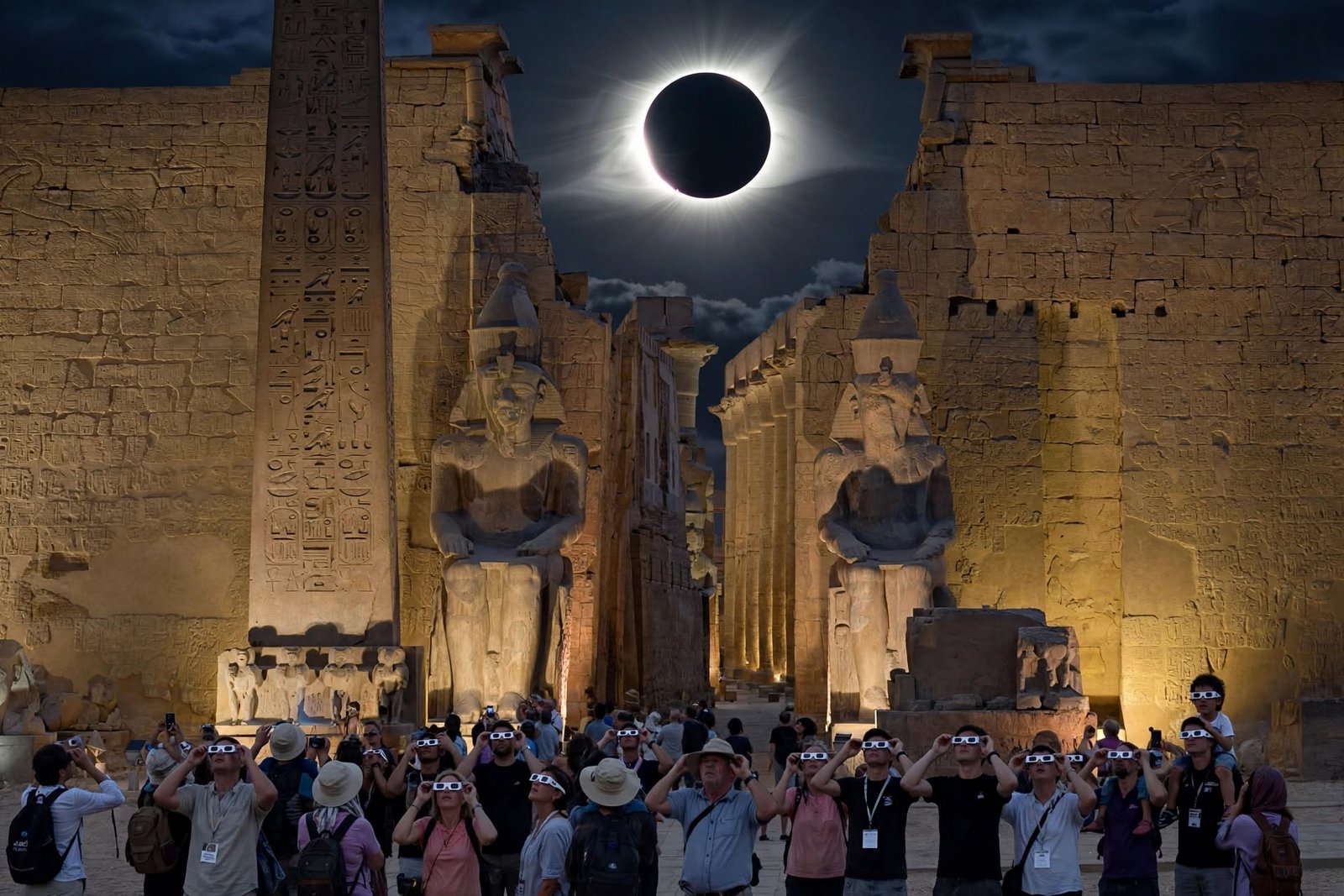
On Monday, August 2, 2027, the sky over Upper Egypt will go dark in the middle of the day. A total solar eclipse in Egypt will sweep across the Nile Valley, and for a few extraordinary minutes, the temples of Luxor will stand beneath a black sun ringed by fire. This isn't just another eclipse; it's the longest total solar eclipse visible from land until the year 2114, and Egypt sits almost exactly at its center.
If you're planning to see it, here's everything you need to know: when it happens, where to stand, how long it lasts, what it will actually look like, and how to prepare without wading through vague travel-blog fluff or dry astronomical tables.
When Is the Solar Eclipse in Egypt 2027?
The eclipse occurs on August 2, 2027, with totality reaching Luxor at approximately 1:05 PM local time. The Moon's shadow first touches Egyptian soil in the west, near Siwa Oasis, then crosses the Western Desert before reaching the Nile Valley at Asyut, sweeping through Luxor, and continuing east toward the Red Sea coast near Marsa Alam before exiting into Saudi Arabia.
Globally, the path of totality begins in southern Spain and Gibraltar, crosses Morocco, Algeria, Tunisia, and Libya, then enters Egypt before continuing through Saudi Arabia, Yemen, and Somalia. But Egypt holds a unique distinction: because the path passes near the equator here and the Moon appears especially large in the sky that day, totality lasts longer over Egypt than anywhere else on the eclipse's route.
Why This Eclipse Is So Rare
Three astronomical factors line up perfectly for this event:
- The Moon is near perigee (its closest point to Earth), making it appear larger and able to fully block the Sun for longer.
- Earth is near aphelion (its farthest point from the Sun), making the Sun appear slightly smaller.
- The shadow's path runs close to the equator, where Earth's rotation and the Moon's shadow move at similar speeds, slowing the shadow's crossing and stretching out totality.
The result: up to 6 minutes and 23 seconds of totality, a duration not seen since 1991 and one that won't be matched again until 2114.
Best Places to Watch the Eclipse in Egypt
Not every location experiences totality, and duration varies even within the path. Here's how the key sites compare:
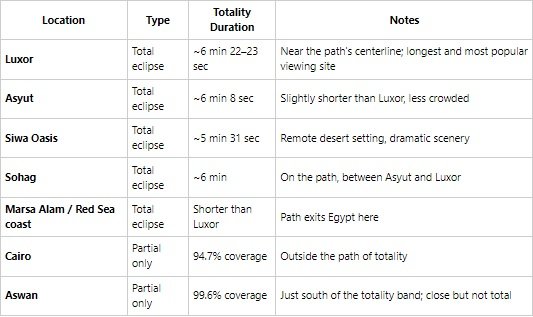
Key takeaway: If your goal is to experience true totality the Moon completely covering the Sun, the sky turning dark, and the solar corona becoming visible you must be inside the roughly 260-kilometer-wide path. Cairo and Aswan, despite being major destinations, will only see a partial eclipse, however dramatic that percentage sounds.
Many visitors choose to combine eclipse day with a Nile cruise from Luxor to Aswan, watching totality from the water before continuing south, or opt for a dedicated Nile cruise to Aswan to see the partial phase from the temples there.
Where Exactly to Stand in Luxor
Because Luxor is expected to draw large crowds, authorities may restrict access to major archaeological sites like Karnak Temple and the Valley of the Kings on eclipse day due to safety and preservation concerns. Realistically, the best vantage points are likely to be:
- Nile-facing hotel rooftops and terraces in Luxor
- River cruise ships anchored or sailing on the Nile at the time of totality
- Open riverside areas along the East and West Banks
- Desert-edge locations slightly outside the city for those wanting fewer crowds
Booking accommodation or a Nile cruise package well in advance is essential; rooms with unobstructed sky views in Luxor are likely to sell out over a year ahead of the event. For travelers who want a more intimate alternative to a large ship, a Dahabiya Nile cruise is worth considering.
How to Watch the Eclipse Safely
A total solar eclipse is only completely safe to view with the naked eye during the brief window of totality itself, when the Moon fully covers the Sun. Before and after that window, direct sunlight is still present and can cause permanent eye damage. Practical safety points:
- Use ISO 12312-2 certified eclipse glasses for all partial phases (before and after totality).
- Never look at the partial phases through a camera, phone, telescope, or binoculars without a proper solar filter.
- You can remove eclipse glasses only during full totality; watch for the "diamond ring" effect to know when totality begins and ends.
- If you're outside the path of totality (Cairo, Aswan), you must keep eclipse glasses on the entire time, since the Sun is never fully covered.
- Photographers should attach solar filters to lenses and remove them only during totality to capture the corona.
What You'll Actually See and Feel
In the minutes before totality, daylight takes on a strange, metallic quality, and temperatures noticeably drop. Shadows sharpen. As totality begins, the sky darkens rapidly, bright stars and planets become visible, and the Sun's outer atmosphere, the corona, appears as a pale, wispy halo around the black disk of the Moon. Birds often go quiet, and a 360-degree sunset glow appears along the horizon. With nearly six and a half minutes of totality in Luxor, viewers will have unusually long time to observe the corona, look for solar prominences, and simply take in the experience; most eclipses offer only two or three minutes.
Frequently Asked Questions
Is the 2027 eclipse visible from Cairo? Only partially. Cairo will see about 94.7% of the Sun covered, but the sky will not go fully dark, and eclipse glasses must be worn throughout. Cairo is still worth combining with a visit to its world-class museums before or after eclipse day.
What is the best city in Egypt to see the total eclipse? Luxor offers the longest totality in Egypt at roughly 6 minutes 22 seconds and has the most developed tourism infrastructure for visitors.
Do I need special glasses if I'm in the path of totality? Yes, for every phase except the brief period of full totality, when the Sun is completely blocked.
How long will the eclipse last overall, including partial phases? The full event, from first partial contact to last, typically spans over two hours, though totality itself lasts only a few minutes.
Will archaeological sites like Karnak Temple be open during the eclipse? This is not yet confirmed, but given expected crowd sizes, restricted access to major heritage sites is likely, with riverside and hotel locations serving as alternative viewing spots.
When should I book accommodation in Luxor? As early as possible; check 5-star hotels in Egypt and Nile cruise availability now. Comparable eclipses elsewhere in the world have seen hotel rooms along the path booked out more than a year in advance.
Is this the longest total solar eclipse ever recorded? No, but it is the longest visible from land since 1991, and no eclipse will surpass it in duration until 2114, making it a once-in-a-lifetime event for most viewers.
Can I photograph the eclipse with just a smartphone? Yes, modern smartphones can capture totality reasonably well, but you'll need a solar filter for the partial phases and a steady mount for best results.
Final Thoughts
The 2027 total solar eclipse gives Egypt something no marketing campaign could invent: nearly six and a half minutes of daytime darkness over the Nile Valley, framed by some of the world's most storied ancient landmarks. Whether you choose Luxor for the longest totality, Asyut or Sohag for smaller crowds, or Siwa for a dramatic desert backdrop, the key decision is the same: get inside the path of totality, book early, and protect your eyes. This is not an event that repeats on a convenient schedule; the next eclipse of comparable length won't arrive until 2114.
If you'd like help planning the trip itself, explore our Egypt travel guide, browse luxury Egypt tours, or look into VIP Egypt experiences for a fully guided eclipse-day itinerary.

