

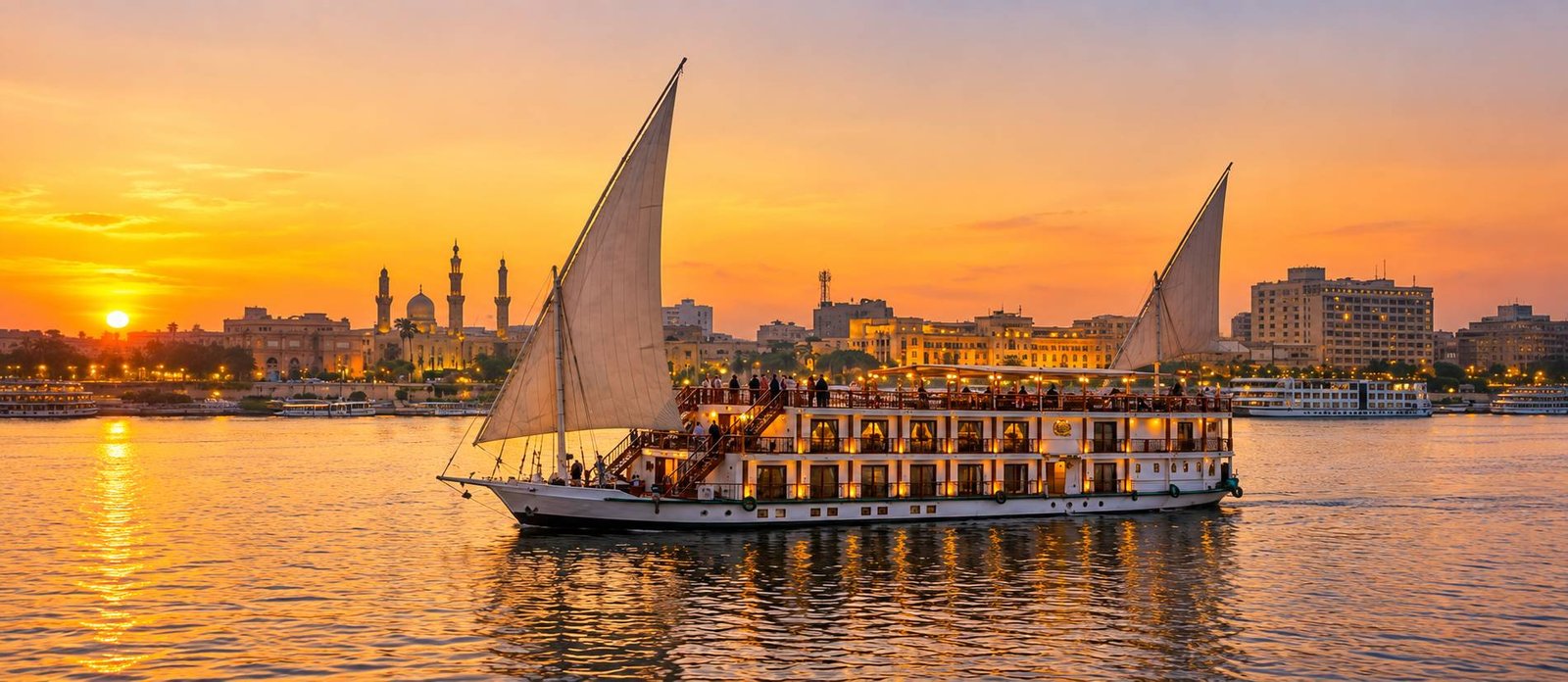
If you've started researching a trip to Egypt, you've probably noticed that "Nile cruise" search results throw a lot at you: dozens of ship names, vague words like "luxury" and "5-star," and price tags that swing from a few hundred dollars to several thousand with very little explanation of what actually separates one ship from another. This guide fixes that. Instead of listing every vessel on the river, it walks through how the Nile cruise fleet is actually organized, what the cabins and decks really look like once you're on board, and how to read past the marketing language to figure out which type of ship is right for you.
What Counts as a "Cruise Ship" on the Nile?
The term "Nile cruise ship" actually covers several quite different types of vessels, and knowing the difference matters more than knowing any individual ship's name.
Standard Nile cruisers (floating hotels). These are the ships most people picture: multi-deck vessels, typically three to five decks tall, carrying anywhere from 60 to over 150 passengers. They function exactly like a hotel that happens to move: restaurant, bar, small pool, sun deck, and a full run of standard, deluxe, and suite cabins. This is the category that dominates the Luxor to Aswan Nile cruise route and makes up the bulk of the fleet you'll see docked along the riverbank in either city.
Dahabiyas. A dahabiya Nile cruise is a much smaller sailing vessel, usually carrying somewhere between 6 and 12 cabins. Traditionally these were graceful two-masted sailboats used by wealthy travelers in the 19th century, and modern dahabiyas lean into that heritage: no engine noise, a slower pace, and a far more intimate, personal atmosphere than a 100-cabin cruiser. They cost more per night but carry far fewer passengers, so the experience feels closer to a private charter than a hotel cruise.
Feluccas. These are small, traditional single-sail wooden boats used mostly for short day trips or single-night sails, not multi-day cruises. If a listing describes a "felucca cruise," understand that it's a very different (and far more basic) experience than a cabin-based cruise ship: no private cabins with beds in the conventional sense, and no onboard restaurant or pool.
Lake Nasser cruisers. South of the Aswan High Dam, an entirely separate small fleet operates on Lake Nasser rather than the river itself, visiting remote sites like Abu Simbel, Amada, and Kalabsha. These ships never sail the Luxor–Aswan stretch at all, so if a "Nile cruise" search result mentions Lake Nasser, it's describing a different itinerary and a different, much smaller fleet.
Understanding which category a ship falls into before you look at price or star rating will save you from comparing two genuinely incomparable products.
How Big Is the Nile Cruise Fleet?
There is no single, universally agreed public figure for exactly how many cruise ships currently operate on the Nile; the number shifts as older vessels are retired, refurbished, or repurposed as static floating hotels, and as new ships launch. What can be said with confidence is that the Luxor–Aswan corridor is served by a substantial fleet, commonly discussed in the low hundreds of vessels when older and currently-dormant ships are included, concentrated overwhelmingly in the standard-cruiser category described above. The dahabiya and Lake Nasser fleets are each far smaller, typically a few dozen vessels at most. If fleet size matters to your decision (for instance, because you want to understand how much competition and choice exists at your budget level), treat any specific number you find online as a rough, time-sensitive estimate rather than a fixed fact, and check with a current operator for what's actually sailing during your travel dates.
Nile Cruise Routes: Where the Fleet Actually Sails
Before comparing cabins, it helps to know where each type of ship actually goes, since route and ship type are closely linked.
- Luxor to Aswan (or the reverse) is the classic, most heavily served route, typically run as a 3-, 4-, or 7-night itinerary, stopping at Edfu, Kom Ombo, and Esna along the way. The vast majority of standard cruisers and dahabiyas operate here, and it's the route behind most of the Nile cruise packages you'll see advertised.
- Cairo to Aswan, sometimes marketed as a "long Nile cruise," is a much longer, multi-week itinerary covering the full length of the navigable river. Only a small handful of specialist ships run this route, since it requires more time, more locks, and more logistical coordination than the shorter southern route.
- Lake Nasser, as noted above, is served by its own separate fleet and itinerary entirely south of Aswan.
If you see a ship advertised for one of these routes, it's a strong clue about its size and class. Cairo–Aswan long-cruise vessels, for instance, tend to be older, purpose-built ships rather than the newer standard cruisers built for the shorter southern run.
Nile Cruise Ship Classes Compared
Within the standard-cruiser category, ships are generally marketed across three loose tiers. None of these tiers is governed by an internationally standardized star-rating body the way hotel stars often are in Europe or North America. Egyptian Nile cruise "star" classifications are set locally and vary in how strictly they're applied, so treat any specific star claim as directional rather than guaranteed.
Standard/budget ships. Typically older vessels, simpler finishes, smaller cabins (often in the 12–15 sqm range), buffet-style dining, and a straightforward sun deck with a small plunge pool. These are perfectly comfortable for most travelers and represent the best value per night on the river.
Deluxe/mid-tier ships. Slightly larger cabins, often with panoramic or French-balcony windows, a more polished dining room with some à la carte options, and better-maintained public areas. This tier covers the largest share of ships actually booked by international travelers.
Luxury/5-star ships. The newest or most recently refurbished vessels, larger suites (sometimes 25 sqm or more), higher crew-to-guest ratios, spa or fitness facilities, and finer dining. If this tier is what you're after, it's worth browsing a luxury Nile cruise Egypt itinerary specifically, since prices here can run two to four times the standard tier for a comparable itinerary length.
Dahabiyas, as a separate category rather than a "tier," sit at a similar or higher price point than luxury cruisers but for a fundamentally different reason: exclusivity and intimacy rather than scale or facilities. A dahabiya rarely has a pool or spa, but it offers something a 120-cabin ship can't: a genuinely small, quiet group and a slower, more flexible pace.
What Cabins and Decks Actually Look Like
This is where marketing language and reality diverge most, so it's worth being concrete.
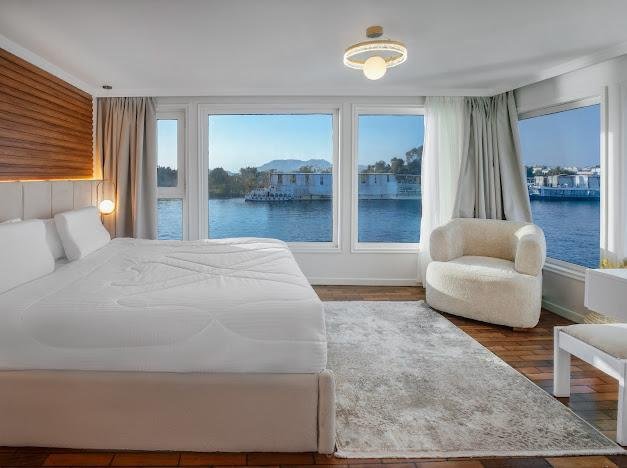
Cabin size. Across standard and deluxe ships, expect somewhere between 12 and 20 square meters for a standard cabin, with luxury-tier suites running larger. This is smaller than most hotel rooms but comparable to a modest ocean-cruise cabin; the emphasis on Nile ships is on shared spaces (sun deck, lounge, dining room) rather than sprawling private cabins.
Windows and balconies. Lower-tier and older ships often have fixed picture windows. Mid-tier and luxury ships increasingly offer "French balconies": a large sliding window that opens but has no exterior walking space, which is different from a true walk-out balcony, so don't assume "balcony" in a listing means what it would on an ocean liner.
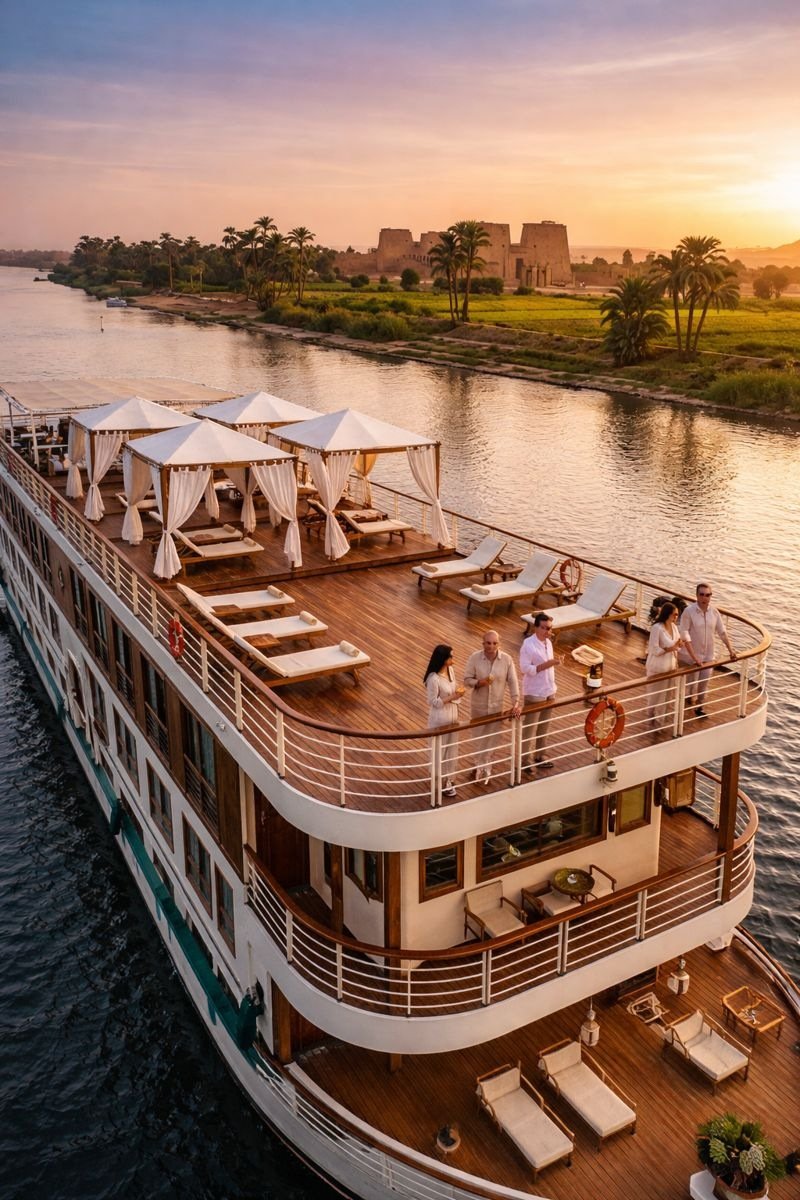
Deck layout. Most standard cruisers run three to five decks: a lower deck (often the least expensive cabins, closer to engine noise), one or two middle decks (the bulk of standard and deluxe cabins), and a top sun deck with loungers and a small pool, which typically doubles as the venue for evening entertainment. Elevators are not universal; plenty of ships rely on stairs between decks, which is worth knowing if mobility is a concern for anyone in your group.
Onboard facilities. Expect a main restaurant (usually buffet-style even on higher-tier ships, with à la carte options increasingly common at the luxury end), a bar/lounge, a small boutique or gift shop, and on mid-to-luxury ships, a compact spa or fitness room. A full-size gym or lap pool is not realistic to expect on any Nile vessel; space simply doesn't allow it.
Wi-Fi. Nearly every modern ship advertises Wi-Fi, but connectivity along the river is genuinely patchy in practice, especially between towns. It's reasonable to expect intermittent access rather than reliable streaming-quality internet for the length of the cruise.
A Day Aboard, in Practice
Numbers and specs only tell part of the story. A typical day on a standard Luxor–Aswan cruise starts early: a wake-up call ahead of a morning temple excursion (Karnak, Edfu, or Kom Ombo, depending on the day), followed by breakfast back on board once the ship has sailed to its next stop. Afternoons are often left open for sun-deck time or a shorter second excursion, and the ship typically covers most of its river distance overnight or during these lower-activity windows. Evenings usually bring a themed dinner or onboard entertainment a galabeya party or folkloric show is common on standard and deluxe ships, while dahabiyas tend to keep evenings quieter and more low-key, in keeping with their smaller scale.
Is It Safe? A Few Honest Notes
Safety and hygiene are reasonable things to ask about before booking a cabin you'll sleep in for several nights. Reputable, well-maintained ships run onboard water treatment and purification systems, and standard safety briefings and life-jacket provisions are normal practice across the fleet. That said, ship age and maintenance standards vary significantly across a fleet this large, so it's worth checking recent, dated reviews for the specific ship you're considering, not just an operator's overall rating before you book, and sticking with bottled water on board as a simple precaution.
Nile Cruise Ship vs. Ocean Cruise Ship
If your only cruise reference point is an ocean liner, recalibrate a few expectations: Nile ships are far smaller (dozens to a couple hundred passengers, not thousands), there's essentially no seasickness risk since you're on a calm river, days are excursion-heavy rather than built around sea days, and the overall pace and formality is more relaxed. Per-night cost for a comparable cabin tier is often lower than an equivalent ocean cruise, largely because the ships themselves are smaller and simpler to operate.
How to Choose the Right Ship for You
- Couples/honeymooners: a deluxe or luxury standard cruiser, or a dahabiya if privacy and a slower pace matter more than onboard facilities.
- Families: a larger standard or deluxe cruiser with more communal deck space and a straightforward daily excursion rhythm.
- Solo travelers: check the single-supplement policy before you book; most ships charge a surcharge for solo occupancy of a double cabin, and this is rarely advertised upfront.
- Multi-generational groups: confirm elevator access if anyone has mobility concerns, since stairs-only layouts are common.
- Budget-conscious travelers: standard-tier ships in shoulder season (roughly April–May or September–October) offer the best value without a major drop in comfort.
Questions Worth Asking Before You Book
Beyond price, ask: how old is the ship and when was it last refurbished, what is the crew-to-guest ratio, which deck is your cabin on (and how close to the engine), is the cabin window fixed or a French balcony, and what is the single-supplement policy if you're traveling alone. A good operator should answer all of these specifically rather than in general marketing terms.
The Bottom Line
The Nile cruise fleet is large, varied, and inconsistently described online, but once you understand the real categories (standard cruiser, dahabiya, felucca, Lake Nasser vessel), the honest cabin and deck realities, and the practical questions worth asking, choosing a ship becomes far less overwhelming than scrolling through dozens of near-identical listings. Match the ship type to how you actually want to spend your days on the water, confirm the concrete details rather than the marketing adjectives, and the rest of the decision gets much easier.

