

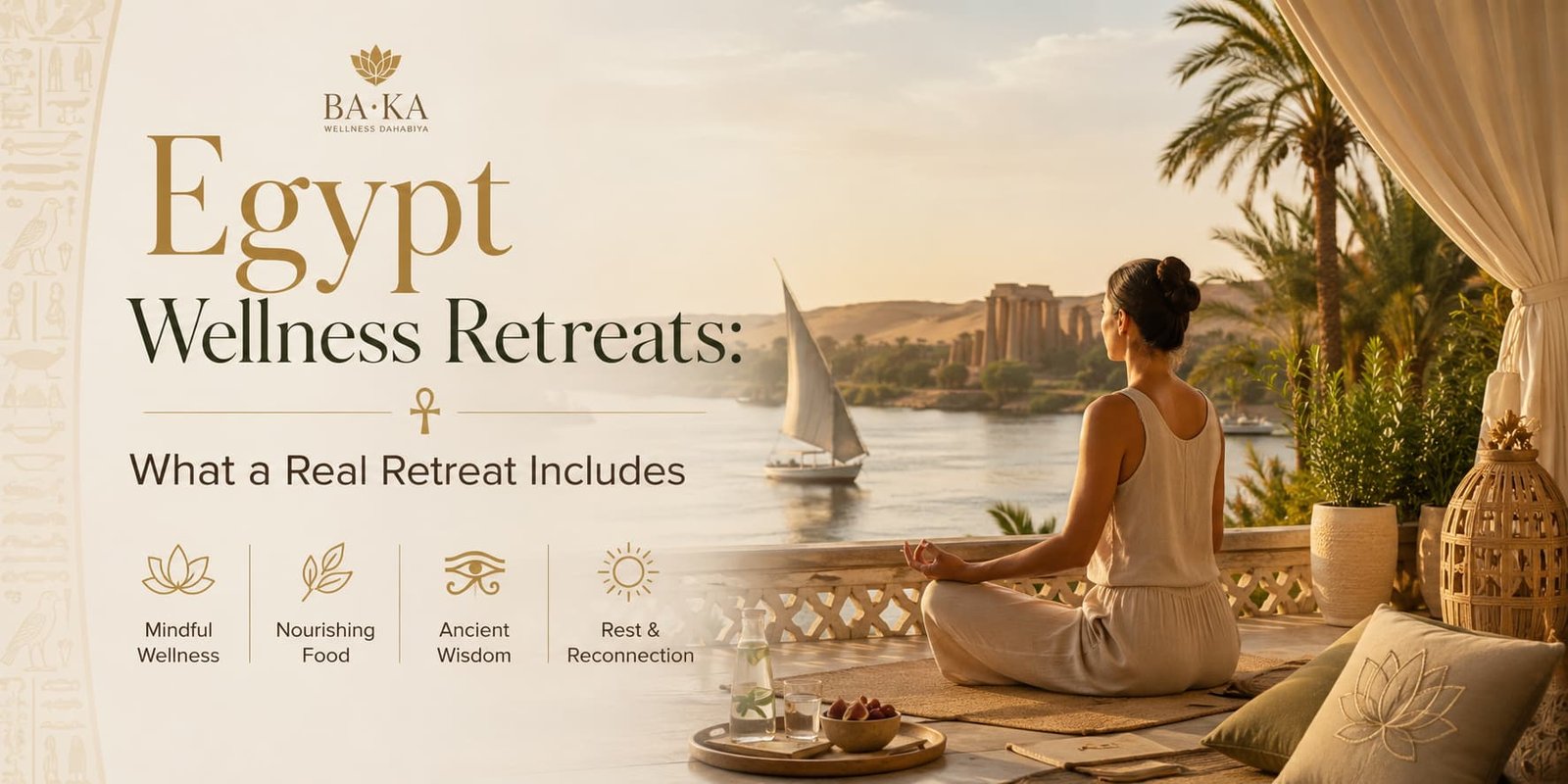
Most "wellness retreats" in Egypt are spa add-ons. Here's what a real one includes: setting, daily rhythm, tradition, and group size before you book.
A real wellness retreat in Egypt combines three things at once: a private, slow-paced setting away from crowds; a daily rhythm built around rest and ritual instead of sightseeing; and healing practices drawn from a specific tradition rather than a generic spa menu. Most listings that rank for "wellness retreat Egypt" are hotel spa packages with a yoga class bolted on top. A genuine retreat is a different product entirely; the whole week is designed around one goal: restoration, not itinerary coverage.
Here's what actually separates a real Egypt wellness retreat from a spa add-on, and what to check before booking one.
1. A Setting Built for Stillness, Not Sightseeing
Standard Nile cruises optimize for coverage as many temples, tombs, and stops as the schedule can fit into four or five days. A wellness retreat in Egypt optimizes for the opposite: fewer stops, more time in silence, and a setting private enough that the outside world doesn't intrude on it.
On a dahabiya Egypt's traditional two-masted sailing vessel this shows up structurally, not just in marketing copy. Dahabiyas carry a small number of guests, typically under 20, move under sail rather than engine noise, and can moor away from the larger cruise-ship docks used by mass-market boats. A retreat built on this kind of vessel gives its group private access to the deck, the dining space, and the mooring point, rather than sharing them with unrelated passengers.
What to check before booking: ask whether "private" means a private cabin, a private boat, or a private dock and entrance for the group. These are three different levels of exclusivity, and the gap between them is usually what drives the price difference between a Nile wellness retreat and a standard cruise cabin.
2. A Daily Rhythm, Not a Checklist
A spa weekend gives you one massage and a menu of optional extras. A genuine holistic retreat in Egypt gives you a fixed daily rhythm designed around energy, digestion, and rest cycles usually anchored around sunrise and sunset, both of which carry ritual weight in ancient Egyptian tradition.
A typical day on a real Egypt wellness retreat looks less like a tour itinerary and more like a residential program:
- Early movement practice at sunrise, often on deck facing the river
- A guided rest or breathwork session mid-morning
- A slow, unhurried lunch built around the day's theme
- Free time for reflection, journaling, or a private treatment
- An evening ritual tied to sunset the point where BA-KA's ancient Egyptian soul philosophy (the concepts of Ka, the life-force, and Ba, the soul) is introduced as the organizing idea behind the day, not as decoration
The absence of a packed excursion schedule is the point of the program, not a gap in it.
3. Practices Rooted in a Specific Tradition
This is the detail most Egypt wellness retreat listings skip entirely. "Wellness" is often used as a catch-all label attached to any trip that includes a massage. A retreat with genuine depth draws its practices from a defined philosophical source. For BA-KA, that source is the ancient Egyptian understanding of the soul as several interconnected parts Ka, Ba, and Akh and restoration is framed as reconnecting them, not simply "relaxing."
Concretely, that means sessions are led by practitioners who can explain why a ritual is sequenced the way it is, not generic yoga-and-massage staff rotated in from a hotel spa roster. If a retreat can't name the tradition its program is built on, it's a spa package wearing a wellness label not a retreat.
4. Food as Part of the Program, Not a Side Menu
On a genuine retreat, meals are planned to support the day's rhythm: lighter, plant-forward dishes earlier in the day, and a shared, unhurried dinner as a closing ritual rather than a formality. This is worth asking about directly. A retreat that serves the same buffet menu as a standard Nile cruise hasn't actually built food into its program it's simply catering a cruise with a different label on the brochure.
5. Group Size Small Enough to Matter
Group size is the single biggest predictor of whether a wellness retreat in Egypt delivers what it promises. A boutique dahabiya carrying 10–18 guests can hold a shared silence during a sunrise practice. A vessel carrying 100 or more passengers cannot, regardless of how the listing is worded. When comparing options, guest capacity is a more reliable signal than any adjective in the description.
6. Transparent Inclusions Especially at the Top of the Market
At the higher end of the market, private access is often the main differentiator, and it should be itemized clearly: a private mooring or entrance, private practitioner sessions versus group sessions, and private dining versus shared seating. A listing price with no breakdown of what "private" actually covers makes it difficult to compare offers fairly, and it's a fair question to ask any provider directly.
BA-KA's Luxurious Wellness Dahabiya package with Private Entrance is priced at $4,980 (pending final confirmation before publishing see verification note above) and is built around exactly this kind of exclusivity: a private access point, a small group size, and a full daily program rather than optional spa add-ons.
7. The Right Season Matters More Than It Does on a Standard Cruise
Timing affects a wellness retreat differently than it affects a standard sightseeing cruise. Heat is manageable for a few hours of temple-hopping with air-conditioned transfers in between, but it works against a program built on outdoor sunrise practice, slow pacing, and long stretches on deck. The October-to-April window is generally the most workable stretch for a Nile wellness retreat, with cooler mornings and evenings that make the sunrise and sunset rituals genuinely comfortable rather than something to push through.
This is also a fair question to put to any retreat provider directly: ask which months their program actually runs in, and whether the daily schedule shifts with the season (later sunrise sessions in winter, earlier ones in warmer months, for example). A provider that hasn't thought through how heat affects an outdoor program likely hasn't built a real one.
Who a Wellness Retreat in Egypt Is Actually For
Not every traveler wants this. Someone who wants to see the Valley of the Kings, Abu Simbel, and Karnak Temple in one trip is better served by a standard Nile cruise or a multi-stop touring itinerary — a wellness retreat deliberately trades sightseeing volume for depth and rest, and treating it as a sightseeing trip with extra yoga will leave that traveler disappointed.
A genuine Egypt wellness retreat tends to fit three kinds of travelers well:
- Someone recovering from a stretch of burnout who needs unscheduled time more than a checklist of monuments
- A returning visitor who has already done the major sites and wants a different kind of trip on the same river
- Someone specifically drawn to ancient Egyptian spiritual philosophy who wants the trip built around that framework, not added on to a standard itinerary
If none of those describe the traveler, a standard Nile cruise is very likely the better fit — and a retreat provider should be honest about that rather than selling the wrong trip.
The Real Test Before Booking a Wellness Retreat in Egypt
Ask any provider these four questions. If they can't answer clearly, it's a spa trip wearing a wellness label, not a retreat:
- What is the maximum number of guests on this sailing?
- What tradition or philosophy structures the daily program?
- What exactly does "private" cover — cabin, vessel, or entrance and dock?
- What does a typical day look like, hour by hour?
A genuine retreat should answer all four without hesitation, because the program was designed around those answers — not written afterward to fit a marketing brief.
Frequently Asked Questions
What makes a wellness retreat in Egypt different from a Nile cruise? A Nile cruise is built around covering sights — temples, tombs, and stops on a fixed schedule. A wellness retreat is built around a daily rhythm of rest, movement, and ritual, with far fewer stops and much more unscheduled time built in by design.
How many guests are typically on a wellness retreat dahabiya? Boutique dahabiyas used for wellness retreats typically carry under 20 guests, compared to 100 or more on a standard cruise ship — the smaller number is what allows shared silence and genuine privacy during practices.
What does "private entrance" mean on a wellness retreat package? It typically refers to a private mooring or dock point, separate from the shared cruise-ship terminals, meaning guests board and disembark without passing through crowded public docks.
Ready to see what a full week looks like? Request the retreat itinerary for BA-KA's Luxurious Wellness Dahabiya, Private Entrance, and get the day-by-day program, inclusions, and current availability

